
The Complete Guide to Custom Cocktails: From Your Vision to a Perfect Glass
How to Design Signature Drinks That Tell Your Love Story
There’s a moment that happens at nearly every wedding we work with. It’s usually during the cocktail hour. A guest takes that first sip of your signature cocktail – the one you spent weeks designing, the one that’s uniquely yours – and their face lights up. They taste something unexpected. Something delicious. Something that couldn’t be served at any other wedding. Then they turn to the person next to them and say, “This is amazing. What is this?” That’s the power of custom cocktails. It’s not just a drink. It’s an experience. It’s a detail that elevates your entire wedding. And it’s something you absolutely can create, even if you’ve never designed a cocktail before.
And that’s when it hits you: you’ve created something memorable. Something that will be part of how people remember your wedding. Not just for the taste, but for what it represents. Your love story. Your personality. Your celebration.
That’s the power of a signature cocktail. It’s not just a drink. It’s an experience. It’s a detail that elevates your entire wedding. And it’s something you absolutely can create, even if you’ve never designed a cocktail before.
In this guide, we’re sharing everything we’ve learned about custom cocktail design from working with hundreds of couples. We’ll walk you through the entire process – from your initial vision to the perfectly garnished glass that greets your guests.
Why Signature Cocktails Matter (More Than You Might Think)
Before we talk about how to design a custom cocktail, let’s talk about why it matters.
The Psychology of a Signature Cocktail
When you serve a signature cocktail at your wedding, you’re doing several things at once:
You’re telling a story. The name, the flavors, the colors—they all communicate something about you as a couple. A cocktail called “Tropical Sunset” communicates something different than one called “New York State of Mind.” Your cocktail says something about who you are.
You’re creating a memory. Years from now, when your guests think about your wedding, they’ll remember your cocktails. They might not remember every song that played or every appetizer served, but they’ll remember your signature drink. They’ll say things like, “Do you remember those amazing cocktails at Sarah and Mike’s wedding?”
You’re setting a tone. A sophisticated craft cocktail sets a different tone than a light, fruity drink. A complex, challenging flavor profile says something different than an approachable, crowd-pleasing option. Your cocktail helps set the vibe for your entire celebration.
You’re creating a talking point. Guests will ask what’s in it. They’ll want to know how to make it at home. They’ll text you weeks later asking for the recipe. Your signature cocktail becomes part of the story of your wedding.
You’re showing thoughtfulness. A couple that takes the time to design custom cocktails is showing their guests that they care about the details. That they’ve thought about the experience. That nothing is an afterthought. That signal of care and attention to detail elevates the entire event.
What Makes a Great Signature Cocktail
Not all signature cocktails are created equal. Some fall flat. Some are too strong or too sweet. Some look beautiful but taste mediocre. Some taste delicious but look plain.
A great signature cocktail hits several marks:
It’s delicious. This should go without saying, but you’d be surprised how many signature cocktails are created more for looks than taste. Your cocktail needs to taste genuinely good.
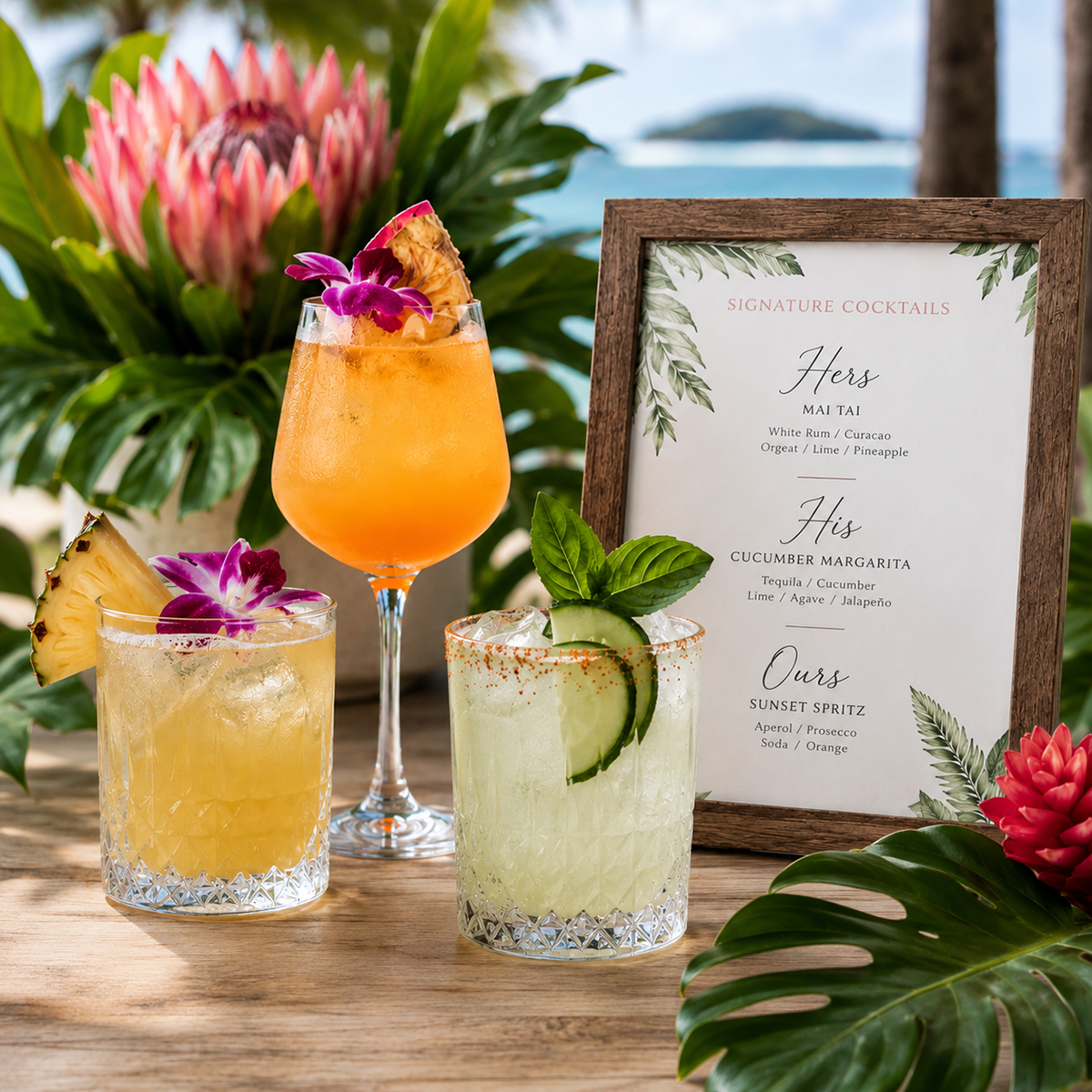
It’s visually striking. Your cocktail will be photographed. Your guests will see it before they taste it. It needs to be beautiful. That might mean a vibrant color, an interesting garnish, or an unexpected presentation.
It’s name-worthy. The name should mean something. It should connect to your story, your location, or your celebration. It should be memorable.
It’s shareable. This is a subtle one, but important. Your guests should feel comfortable ordering it, talking about it, and sharing it on social media (if they’re inclined to do so). It shouldn’t be so unusual that it feels exclusive or strange.
It’s you. More than anything, it should reflect your personality and your style. If you’re not the type of couple who loves tropical fruity drinks, don’t serve a tropical fruity drink just because you’re getting married in Hawaii. Serve something that’s authentically you.
Understanding Flavor Profiles: The Foundation of Cocktail Design
Before you start designing, you need to understand the basics of flavor. Every good cocktail is built on a few foundational concepts.
The Spirit: Your Base
Every cocktail starts with a base spirit. This is usually:
Rum: Versatile, works well with tropical flavors, ranges from light and delicate to rich and complex. Rum is popular for Maui weddings because it feels tropical without being cliché.
Vodka: Neutral flavor, allows other ingredients to shine. If you want the focus to be on fruit flavors or herbal notes, vodka is often the best base.
Gin: Botanically complex, works well with citrus and herbal flavors. Gin cocktails feel sophisticated and craft-oriented.
Tequila: Distinctive flavor, works beautifully with citrus and agave notes. Great if you want something with personality.
Whiskey: Rich, warming, works well with warm spices, citrus, and herbal flavors. Perfect for couples who like classic, grounded flavors.
Brandy or Cognac: Elegant, smooth, works well with softer flavors like peach, berries, or vanilla.
Your spirit choice sets the tone for everything else. Choose a spirit that you genuinely enjoy drinking. If you’re not naturally drawn to rum, don’t base your cocktail on rum just because you’re getting married in Hawaii.
The Sweetness: Balance and Depth
Every cocktail needs some element of sweetness. But sweetness shouldn’t be overwhelming. The sweetness comes from:
Simple syrup: Basic sugar and water, neutral flavor
Flavored syrups: Infused with vanilla, cinnamon, lavender, ginger, etc.
Liqueurs: Pre-made sweetened spirits like triple sec, Cointreau, or fruit liqueurs
Juices and purees: Fresh fruit juices or purees add natural sweetness along with flavor
Honey or agave: These add sweetness and complexity
The right amount of sweetness balances the spirit and other flavors without making the drink taste like dessert.
The Acid: Brightness and Balance
Acid is crucial. It brightens the drink, adds complexity, and prevents it from being cloying or heavy. The primary acids come from:
Fresh citrus: Lime juice, lemon juice, grapefruit juice. This is almost always your best option. Always use fresh juice, never bottled.
Wine or champagne: Adds brightness and elegance
Vinegar-based ingredients: Used sparingly for a subtle tartness
Acid is what makes a cocktail feel fresh and lively rather than heavy and dull.
The Texture and Mouthfeel: Richness and Complexity
Beyond the basic flavor, texture matters. This comes from:
Egg whites: Creates a silky, luxurious mouthfeel and beautiful foam
Cream: Adds richness and body
Milk or coconut cream: Softens and rounds out strong flavors
Herbal infusions: Add complexity and depth
The Garnish: The Final Touch
The garnish isn’t just for looks (though it should look beautiful). It’s the final flavor note.
Citrus peels: Express the oils over the drink for aroma and subtle flavor
Fresh herbs: Mint, basil, rosemary add freshness and aroma
Bitters: A few drops can dramatically change the flavor profile
Edible flowers: Add color and subtle floral notes
Fresh fruit: Adds visual appeal and flavor
A well-chosen garnish completes the cocktail and ties all the flavors together.
The Cocktail Design Process: Step by Step
Now that you understand the components, let’s walk through the actual process of designing your signature cocktails.
Step 1: Define Your Vision
Before you talk to your bartender, spend some time defining your vision. This doesn’t require you to know cocktail terminology. You just need to know what you like.
Ask yourself:
What are your favorite flavors? Think about foods and drinks you naturally gravitate toward. Do you love tropical flavors? Citrus? Herbs? Berries? Spice? This will inform your cocktail design.
What’s your alcohol preference? Do you prefer rum, vodka, gin, tequila, whiskey? Or are you open to anything? If you have a preference, that’s your starting point.
What’s the vibe you want? Are you thinking elegant and sophisticated? Fun and playful? Tropical and beachy? Romantic and luxurious? The vibe should match your wedding overall.
Are you looking for warm or cool flavors? Warm flavors include spices like cinnamon, vanilla, nutmeg, and spirits like whiskey. Cool flavors include mint, citrus, cucumber, light rum.
Do you want something familiar or adventurous? Some couples want a cocktail that their guests will immediately feel comfortable with. Others want something unexpected and unique.
Write down your answers. You’ll share this with your bartender.
Step 2: Have a Vision Conversation with Your Bartender
Schedule a phone or video call with your bartender (or attend a consultation if you’re local). This is where you share your vision.
You might say something like:
“We both love tropical flavors, but we don’t want something that tastes like a piña colada. We’re thinking something sophisticated. Maybe something with rum, passion fruit, and lime. But we’re open to your suggestions.”
A good bartender will ask you questions:
- How strong do you want it? (Some people prefer lighter cocktails, others prefer them stronger)
- How sweet? (Some prefer dry and tart, others prefer balanced sweetness)
- Do you want it shaken or stirred?
- Any ingredients you definitely don’t want?
- What’s your budget per drink?
- How many people will be drinking these?
This conversation is where your vision meets professional expertise. Your bartender might suggest ingredients you didn’t think of, or a different flavor direction that actually works better.
Step 3: The First Draft
Your bartender will propose a recipe. This might be:
The Tropical Escape
- 2 oz golden rum
- 1 oz passion fruit puree
- 0.75 oz fresh lime juice
- 0.5 oz simple syrup
- Top with prosecco
- Garnish: pineapple wedge and fresh mint
You’ll taste this draft (either in person, or you’ll try a similar cocktail so you can evaluate the flavor profile). Then you provide feedback.
Step 4: Refinement and Iteration
This is where the magic happens. You taste the first draft and you have thoughts:
“I love the passion fruit, but it feels a bit too sweet. And I’d like it a bit stronger.”
Your bartender adjusts:
The Tropical Escape (Revised)
- 2.5 oz golden rum
- 1 oz passion fruit puree
- 0.75 oz fresh lime juice
- 0.25 oz simple syrup (half the original)
- Top with prosecco
- Garnish: pineapple wedge and fresh mint
You taste the revision. Maybe it’s better. Maybe you have more feedback:
“This is great, but the passion fruit flavor isn’t coming through as much. Can we use more puree or less lime?”
Your bartender adjusts again. And again. This back-and-forth continues until your cocktail is exactly what you want.
On average, we go through 3-4 iterations before a couple is completely happy. Sometimes it’s 2. Sometimes it’s 5 or 6. That’s all normal and expected.
Step 5: Finalize the Recipe
Once you’re happy, your bartender writes down the exact recipe. Every measurement, every ingredient, every garnish detail. This becomes your official cocktail recipe.
This recipe is important because:
- It ensures consistency. Every bartender making this drink knows exactly how to make it.
- It documents your vision. You have a record of exactly what you created.
- It allows for scaling. If your guest count changes, your bartender can scale the recipe up or down.
Step 6: Naming Your Cocktail
Your cocktail needs a name. This can be:
A reference to your story — “The Sarah & Mike” or “New York Meets San Francisco” (if you’re from different cities)
A reference to your location — “Maui Sunset” or “Tropical Escape”
A reference to a meaningful moment — “First Dance” or “Sunset at Wailea”
Something poetic or playful — “Love in a Glass” or “Island Romance”
The name should be meaningful to you. It will be printed on your menu (if you have one) or explained to guests as they order.
Your bartender can help with this. They’ve named hundreds of cocktails and can offer suggestions or help you refine your idea.
Common Cocktail Design Scenarios
While every couple’s preferences are different, we see some common scenarios. Let’s walk through a few and see how they develop.
Scenario 1: The Tropical Lovers
Couple: Jessica and James, both love tropical flavors, getting married in Maui
Initial Vision: “We want something tropical but not cheesy. Maybe something with rum and fruit, but sophisticated.”
Bartender’s Questions:
- How adventurous are your guests with flavors?
- Do you want something a lot of people will feel comfortable ordering?
- Do you want heat (like spice) or just cool tropical flavors?
First Draft: “Island Elegance”
- 1.5 oz gold rum
- 0.75 oz coconut rum
- 1 oz pineapple juice
- 0.5 oz lime juice
- 0.25 oz vanilla syrup
- Splash of soda water
- Garnish: pineapple leaf, lime wheel
Feedback: Jessica loves the vanilla element but wants more pineapple flavor. James thinks it’s too sweet.
Revision 1: “Island Elegance” (Adjusted)
- 2 oz gold rum
- 0.5 oz coconut rum (reduced)
- 1.25 oz fresh pineapple juice (increased)
- 0.5 oz lime juice
- 0.25 oz vanilla syrup (kept same)
- Splash of soda water
- Garnish: pineapple leaf, lime wheel
Feedback: Better! But now they’re thinking about their second cocktail…
Scenario 2: The Gin Lovers
Couple: David and Marcus, love classic craft cocktails, prefer gin and citrus
Initial Vision: “We want something sophisticated. Maybe gin-based. We like citrus. But we also want it to feel fun and beachy, not stuffy.”
Bartender’s Questions:
- Do you want it shaken or stirred?
- How much body/texture do you want?
- Any botanicals you particularly like or dislike?
First Draft: “The Maui Breeze”
- 2 oz gin
- 0.75 oz fresh grapefruit juice
- 0.5 oz fresh lime juice
- 0.25 oz elderflower liqueur
- 0.25 oz simple syrup
- Top with soda water
- Garnish: grapefruit twist
Feedback: David loves it but wants it slightly stronger. Marcus loves the grapefruit but wonders if adding a splash of prosecco would make it feel more celebratory.
Revision 1: “The Maui Breeze” (Adjusted)
- 2.25 oz gin (increased slightly)
- 0.75 oz fresh grapefruit juice
- 0.5 oz fresh lime juice
- 0.25 oz elderflower liqueur
- 0.25 oz simple syrup
- Splash of prosecco
- Splash of soda water
- Garnish: grapefruit twist
Feedback: Perfect! This is the one.
Scenario 3: The Non-Drinker’s Dilemma
Couple: Lisa and Kevin, Lisa doesn’t drink alcohol, Kevin wants craft cocktails
Initial Vision: “We want to make sure Lisa has something special too, not just juice or soda water.”
Bartender’s Options: A non-alcoholic signature drink (mocktail) that’s equally crafted and special
First Draft: “The Island Refresher” (Non-Alcoholic)
- 2 oz fresh pineapple juice
- 1 oz fresh lime juice
- 0.75 oz coconut cream
- 0.5 oz ginger syrup
- Splash of soda water
- Garnish: pineapple wedge, mint, edible flower
Feedback: Lisa loves it! It’s as elegant and special as Kevin’s gin cocktail.
For Kevin: “The Maui Gin”
- 2 oz gin
- 0.75 oz fresh lime juice
- 0.5 oz pineapple juice
- 0.25 oz simple syrup
- Few drops of aromatic bitters
- Garnish: pineapple wedge, mint
Result: Both Lisa and Kevin have signature cocktails that match their preferences and feel equally special.
The Technical Details: Measurements, Techniques, and Consistency
Once your cocktail is designed, we need to talk about the technical side. This is where consistency and quality come in.
Why Measurements Matter
A cocktail isn’t like cooking, where you can adjust by taste. Cocktails require precision. When you order a cocktail at a top-tier bar, they measure every single ingredient. They use jiggers (measuring tools) to ensure consistency.
Why? Because the ratio of ingredients matters. A cocktail with 2 oz of spirit and 0.75 oz of acid tastes significantly different than one with 2 oz of spirit and 1 oz of acid.
Your wedding bartender should be measuring everything. Not free-pouring. Not estimating. Measuring. This ensures that every guest who orders your cocktail gets the same, delicious experience.
Shaking vs. Stirring
Some cocktails are shaken. Some are stirred. This matters because:
Shaken cocktails (with ice) are aerated, become cold very quickly, and are usually slightly diluted. This works well for cocktails with juices, cream, or egg whites. The aeration and slight dilution lightens the drink.
Stirred cocktails are mixed more gently, chill more slowly, and are slightly less diluted. This works well for spirit-forward cocktails where you want to taste the spirit more prominently.
Your bartender will determine which method works best for your cocktail based on its ingredients and flavor profile.
The Importance of Fresh Ingredients
This cannot be overstated: fresh ingredients make or break a cocktail.
Fresh citrus juice — This must be freshly squeezed. Bottled lime or lemon juice tastes completely different and will ruin your cocktail.
Fresh fruit — For garnish or as an ingredient, it should be fresh, ripe, and beautiful.
Fresh herbs — Mint, basil, or rosemary should be vibrant and aromatic.
Quality spirits — You don’t need the most expensive bottle, but you do need a quality spirit. Your bartender can recommend good mid-range options.
A great bartender will use fresh ingredients for every single drink. This is non-negotiable for a 5-star experience.
Scaling Your Cocktail: From One Drink to 100
Once your cocktail is perfected in single-drink form, we need to think about scaling it up for your wedding.
The Batch Cocktail Advantage
For weddings, bartenders often prepare “batches” of cocktails in advance. Instead of making each drink individually, they’ll pre-mix a large batch of the cocktail (minus the ice and garnish) before service starts.
This has several advantages:
Speed — Guests don’t wait long for drinks Consistency — Every drink is made exactly the same way Efficiency — The bartender can focus on presentation and service rather than measuring
A batch cocktail recipe might look like this:
For 80 guests, serving 2 cocktails per person:
Original recipe (1 drink):
- 2 oz rum
- 1 oz passion fruit puree
- 0.75 oz lime juice
- 0.5 oz simple syrup
Batched recipe (for 160 cocktails):
- 20 oz (approximately 625 ml) rum
- 10 oz passion fruit puree
- 7.5 oz lime juice
- 5 oz simple syrup
- Mix in a large pitcher
- Chill until service
- Pour over ice with prosecco top and garnish
Your bartender handles these calculations. But it’s good to understand that this is how it works.
Special Requests and Dietary Considerations
Your guests might have special requests. Here are common ones:
Non-Alcoholic Version
Many couples want a non-alcoholic version of their signature cocktail. This is easy to do:
Original: “The Tropical Escape”
- 2 oz rum
- 1 oz passion fruit puree
- 0.75 oz lime juice
- 0.5 oz simple syrup
- Top with prosecco
Non-Alcoholic Version: “The Tropical Escape (Virgin)”
- 1 oz rum replace with 1 oz additional pineapple juice
- 1 oz passion fruit puree
- 0.75 oz lime juice
- 0.5 oz simple syrup
- Top with ginger ale or sparkling cider
This maintains similar flavors and structure while eliminating alcohol.
Sugar-Free Option
For guests watching sugar intake:
Original: “The Tropical Escape”
- 2 oz rum
- 1 oz passion fruit puree
- 0.75 oz lime juice
- 0.5 oz simple syrup
- Top with prosecco
Sugar-Free Version: “The Tropical Escape (Light)”
- 2 oz rum
- 1 oz passion fruit puree (passion fruit is naturally occurring sugar, so this is acceptable)
- 0.75 oz lime juice
- 0.25 oz simple syrup (reduced) or substitute with sugar-free syrup
- Top with prosecco
Spice/Heat Sensitivity
If you have guests who can’t handle spice, provide alternatives:
If your signature cocktail includes jalapeño or hot pepper, offer a mild version without the heat element, or provide the spicy element on the side so guests can control the heat level.
Allergen Considerations
If your cocktail includes ingredients that trigger common allergies (nuts, dairy, eggs), make sure:
- Your bartender knows which guests have allergies
- A non-allergenic version is available
- The bar is cleaned between drinks to avoid cross-contamination
This is why that detailed questionnaire we mentioned earlier is so important. Your bartender needs to know about these considerations in advance.
The Photography and Presentation: Making Your Cocktail Instagram-Worthy
Your signature cocktail will be photographed. Your guests will see it before they taste it. So presentation matters.
The Glass
The right glass makes a difference. Options include:
Coupe glass — Elegant, classic, works well for cocktails with a foam top or light texture
Rocks glass — Modern, can feel sophisticated or casual depending on context, good for spirit-forward drinks
Highball glass — Tall and elegant, good for cocktails with a lot of mixer or sparkle
Hurricane glass — Tropical, dramatic, good for fruity, beachy cocktails
Mason jar — Casual, fun, works well for relaxed celebrations
Your bartender will recommend a glass that complements your cocktail.
The Garnish
A beautiful garnish is crucial. Common options:
Citrus wheels or twists — Lime, lemon, grapefruit, or orange. Express the oils over the drink for aroma and visual interest.
Fresh herbs — Mint sprigs, basil, rosemary. Choose herbs that complement your cocktail.
Edible flowers — Pansies, violas, orchids. These add elegance and color.
Fruit — Pineapple wedges, berries, peach slices. Choose fruit that complements the flavors.
Custom elements — Some couples request custom elements. A couple’s initials garnished with edible gold. A theme-specific garnish. Your bartender can execute these if you have ideas.
The Color
Color draws people in. A vibrant, beautiful color makes people want to taste it.
If your cocktail is pale or clear, you might want to adjust ingredients to add color:
- Add a splash of grenadine for a ruby tint
- Use passion fruit puree for a golden hue
- Add butterfly pea flower for a blue hue that changes color when citrus is added
- Use cranberry juice for a ruby color
Color should be authentic to the flavors, not artificial. But if your cocktail naturally looks pale and you want more visual impact, you can adjust.
Cost and Budget Considerations
Your bartender should be transparent about costs. Here’s what affects pricing:
Per-Drink Cost vs. Per-Person Cost
Your bartender might charge:
- A per-drink rate (e.g., $8 per cocktail)
- A per-person rate (e.g., $12 per person for unlimited cocktails)
- An hourly rate plus cost of goods
- A flat rate for the event
Different bartenders charge differently. What matters is that you understand what you’re paying for and that it’s transparent.
Ingredient Costs
Some ingredients cost more than others. A cocktail with premium rum, fresh passion fruit puree, and artisanal bitters will cost more than one with basic rum, simple syrup, and standard lime juice.
Your bartender can work within your budget. If you have a specific budget per drink, tell them. They can design something delicious that fits.
Scaling Costs
The cost per drink often decreases when you’re making large quantities. Making 160 cocktails at once is more efficient than making 160 cocktails one at a time. So the per-drink cost for a wedding is typically lower than the per-drink cost at a bar.
From Vision to Glass: The Complete Journey
Let’s follow one couple’s cocktail design journey from start to finish.
Meet Sophie and Ryan
Sophie is a pastry chef. Ryan is a wine enthusiast. They’re getting married in Maui and want signature cocktails that reflect their personalities.
Initial Vision Conversation (Email)
Sophie: “Ryan loves wine and sophisticated flavors. I love fruit and some sweetness. We want something that feels mature and elegant, but also fun. We’re not into overly strong drinks. And we want something that looks beautiful—something our photographer will love.”
First Consultation (Video Call)
Kirsty (the bartender): “Tell me more about flavors you love.”
Ryan: “I enjoy dry, complex flavors. I love citrus, especially grapefruit. I’m not a big sugar person.”
Sophie: “I love tropical fruit. Passion fruit, mango, pineapple. And I’m not afraid of sweetness, but I don’t want it to taste like dessert.”
Kirsty: “What if we created two cocktails that blend your preferences? One that leans toward Ryan’s style and one toward Sophie’s, but they’re actually complimentary?”
Sophie and Ryan: “Yes! We love that idea.”
First Draft (Kirsty Sends Recipes via Email)
“Ryan’s Sipper” (For Ryan)
- 2 oz gin
- 0.75 oz fresh grapefruit juice
- 0.5 oz fresh lemon juice
- 0.25 oz dry vermouth
- Few drops aromatic bitters
- Twist of grapefruit peel
“Sophie’s Escape” (For Sophie)
- 2 oz rum
- 1 oz passion fruit puree
- 0.75 oz fresh lime juice
- 0.5 oz vanilla syrup
- Top with prosecco
- Garnish: pineapple wedge and edible flower
Their Feedback
Ryan: “Love Ryan’s Sipper. This is exactly what I wanted—dry, complex, not too sweet. Perfect.”
Sophie: “Sophie’s Escape is good, but I feel like it could use more oomph. And the vanilla feels a bit heavy.”
Revision 1
Kirsty adjusts Sophie’s drink:
“Sophie’s Escape” (Revised)
- 2.25 oz rum (increased for more strength)
- 1.25 oz passion fruit puree (increased for more fruit)
- 0.75 oz fresh lime juice (same)
- 0.25 oz vanilla syrup (reduced from 0.5)
- Top with prosecco (same)
- Garnish: pineapple wedge and fresh orchid
Their Feedback
Sophie: “Yes! This is exactly it. The passion fruit is the star now, and the vanilla is just a subtle background note. I love it.”
Ryan: “And I still love mine.”
Naming and Finalization
The cocktails needed names. Sophie and Ryan decided:
Ryan’s Sipper becomes “The Sophisticated Escape” Sophie’s Escape becomes “The Tropical Dream”
Kirsty sends the final recipes via email:
“The Sophisticated Escape”
- 2 oz gin
- 0.75 oz fresh grapefruit juice
- 0.5 oz fresh lemon juice
- 0.25 oz dry vermouth
- Few drops aromatic bitters
- Twist of grapefruit peel
“The Tropical Dream”
- 2.25 oz rum
- 1.25 oz passion fruit puree
- 0.75 oz fresh lime juice
- 0.25 oz vanilla syrup
- Top with prosecco
- Garnish: pineapple wedge and fresh purple orchid
Wedding Day
Sophie and Ryan arrive at their Maui venue the day before their wedding. They walk through the cocktail area and see beautiful signage:
“The Sophisticated Escape” — A gin-forward experience with grapefruit brightness
“The Tropical Dream” — A rum-based escape with passion fruit and prosecco
The next day, during cocktail hour, guests arrive and are offered their choice of cocktails. The bartender hands them a beautiful glass with the perfectly garnished drink and the signature name.
Guests taste them and immediately understand: this couple put thought into every detail. These cocktails aren’t generic. They’re personal. They’re delicious. They’re memorable.
The Mistakes to Avoid
As bartenders who’ve designed hundreds of cocktails, we’ve seen couples make some common mistakes. Here’s what to avoid:
Mistake #1: Designing by Looks, Not Taste
Your cocktail needs to look beautiful, but not at the expense of taste. A drink that looks gorgeous but tastes mediocre will disappoint your guests. Prioritize taste first, then make it look beautiful.
Mistake #2: Over-Complicating It
Simple is often better. A perfectly executed simple cocktail is better than a complex cocktail with seven ingredients that doesn’t quite work. Your bartender should push back if your ideas are getting too complicated.
Mistake #3: Ignoring Your Guests’ Preferences
You love spicy food, so you want a cocktail with hot pepper. But your grandmother doesn’t like spice. Make sure your signature cocktail is something most of your guests will enjoy. Or have a second option for guests with different preferences.
Mistake #4: Not Considering Batch Preparation
A cocktail that’s beautiful when made individually might not look the same when batched. Work with your bartender to ensure your cocktail scales beautifully to full-wedding quantities.
Mistake #5: Skipping the Testing Phase
Don’t skip testing. Make sure your cocktail is actually delicious before you commit to serving it at your wedding. Taste it. Tweak it. Taste it again.
Mistake #6: Cutting Corners on Ingredients
Using bottled lime juice instead of fresh. Using artificial sweeteners instead of real simple syrup. Skipping the garnish. These corners show. Your guests will taste the difference. Don’t cut corners on ingredients.
Ready to Design Your Signature Cocktails?
Designing a signature cocktail isn’t as hard as it seems. You don’t need to be a bartender. You don’t need to know cocktail terminology. You just need to know what you like, and you need a bartender who understands your vision and has the expertise to execute it.
The process is collaborative. Your vision. The bartender’s expertise. Testing and refinement. Until you have a cocktail that’s delicious, beautiful, and uniquely yours.
At Aloha Bars Maui, we’ve designed hundreds of custom cocktails. We’ve worked with couples who had crystal-clear visions and couples who were starting from scratch. We’ve created cocktails that were simple and elegant. Cocktails that were complex and adventurous. Cocktails that reflected love stories and celebrations and personalities.
And every single one was memorable.
Your signature cocktail is waiting to be created. Let’s design it together.
Your Signature Cocktail Journey Starts Here
Contact Kirsty for a complimentary cocktail consultation
Phone: 1-808-990-5725
Website: alohabarsmaui.com
Email: Available through website contact form
Let’s design a cocktail that’s as unique as your love story. A drink your guests will remember. A detail that elevates your entire celebration.
From your vision to a perfect glass. That’s what we do.
