
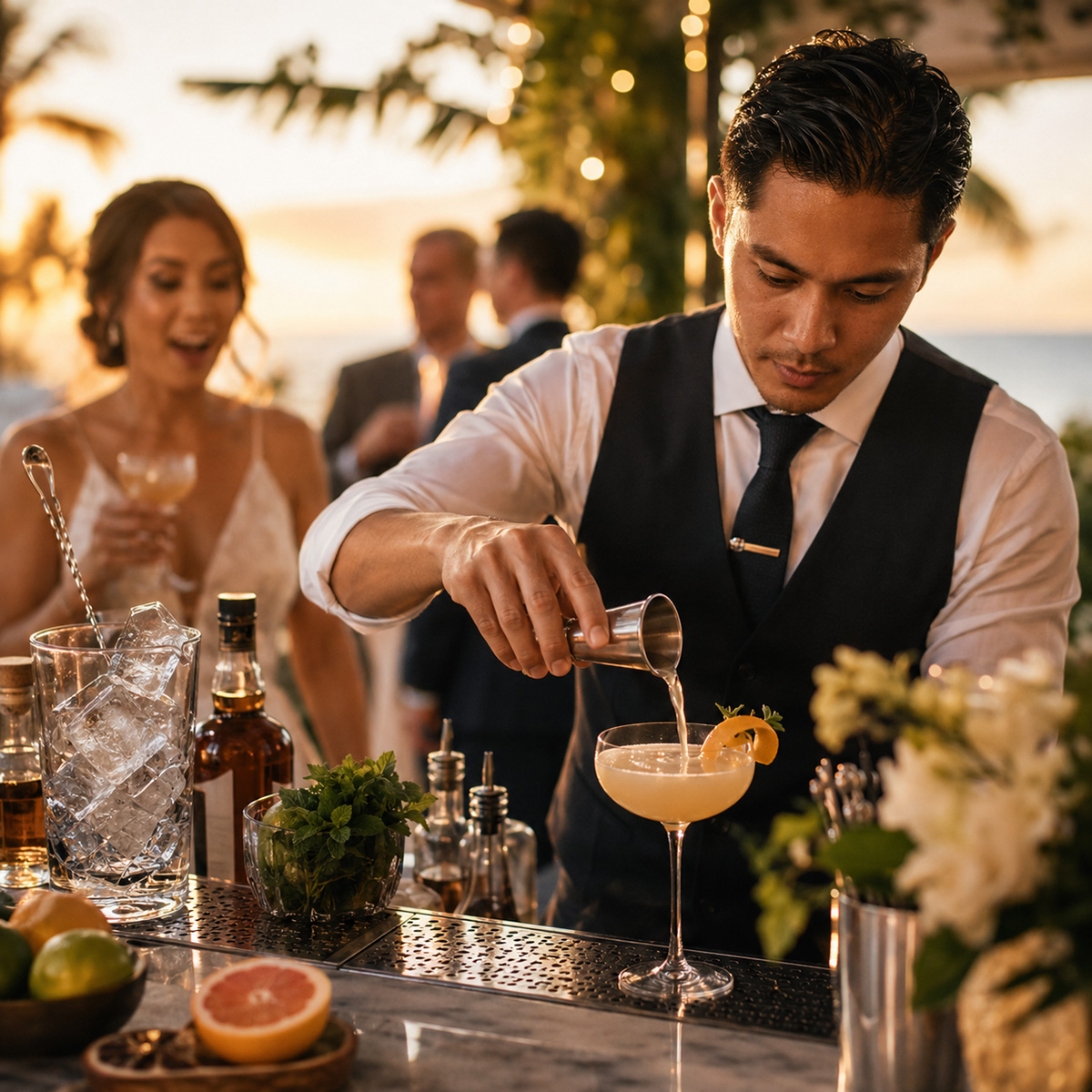
The Science and Art of Precision Bartending: Why Craft Cocktails Matter
What Separates Good Bartending from Exceptional Bartending
There’s a moment at nearly every wedding where someone takes a sip of their cocktail and their expression shifts. Not a casual “oh, that’s nice,” but a genuine moment of recognition. They taste something they weren’t expecting. The flavors are balanced. The drink is cold. The proportions are perfect. And they think, “This bartender actually knows what they’re doing.” That moment – that recognition of quality – comes from precision craft cocktails bartending.
A casual bartender might throw ingredients together, estimate measurements, and call it a day. The drink is fine. It gets the job done. But it’s not the drink a guest will remember months later.
A precision bartender measures every ingredient. They understand the science of how spirits, mixers, and acids interact. They know why temperature matters, why ice quality matters, why technique matters. And they execute with consistency and care.
The difference isn’t just taste. It’s the difference between a bartender and a craft bartender. Between a service and an experience.
In this guide, we’re exploring the science and art of precision bartending. We’re explaining what makes a bartender exceptional. And we’re showing you why precision matters for your wedding celebration.
Bartending as Science: The Fundamentals
Let’s start with the science. Because cocktails, despite their creative reputation, are actually deeply rooted in measurement, chemistry, and physics.
The Importance of Precise Measurement
Here’s a fundamental truth: cocktails are not like cooking. You can’t adjust by taste as you go. You measure, you mix, and you have one chance to get it right.
Why? Because the ratio of ingredients fundamentally changes the drink.
Consider two versions of the same cocktail:
Version A:
- 2 oz spirit
- 1 oz acid (lime juice)
- 0.75 oz sweet component
- Result: Balanced, bright, refreshing
Version B:
- 2 oz spirit
- 0.5 oz acid (half the lime)
- 0.75 oz sweet component
- Result: Dull, sweet, unbalanced
The only difference is 0.5 oz of lime juice. But it completely changes the character of the drink.
This is why precision bartenders use jiggers (measuring tools) for every single ingredient. Not free-pouring. Not estimating. Measuring.
A standard cocktail jigger has measurements marked: 0.5 oz, 0.75 oz, 1 oz, 1.5 oz, 2 oz. The bartender measures each ingredient into the jigger, then pours it into the mixing vessel. Every single time. No guessing. No “that looks about right.”
The ABV (Alcohol by Volume) Equation
When you measure precisely, you control the alcohol content of your drink.
Most cocktails are designed to be around 15-17% ABV (alcohol by volume). This is strong enough to taste like a real drink, but not so strong that it’s overwhelming.
If a bartender free-pours and doesn’t measure, they might end up with 12% ABV (too weak) or 22% ABV (too strong). Neither matches the intended drink.
Your wedding guests deserve consistency. The first person to order your signature cocktail should taste the same drink as the last person, three hours later. Precision measurement ensures this.
Dilution and Temperature: Critical Factors
This is where the science gets interesting. When you add ice to a cocktail and shake or stir it, two things happen:
1. The drink gets cold. Ice brings the temperature down to optimal serving temperature (typically 28-32°F for most cocktails).
2. The ice melts slightly, diluting the drink. This is intentional and crucial.
Why is dilution important? Because dilution:
- Opens up flavors
- Makes strong spirits more balanced
- Rounds out sharp edges
- Creates proper texture and body
A professional bartender controls dilution by:
- The length of time they shake or stir
- The amount and type of ice used
- The glassware (which affects dilution rates)
Too little dilution = harsh, overly spirited drink Correct dilution = balanced, smooth, excellent drink Too much dilution = weak, watered-down drink
A precision bartender knows exactly how long to shake or stir to achieve optimal dilution for each specific cocktail.
Ice Quality: The Unsung Hero
Most people don’t think about ice. But ice quality fundamentally affects cocktail quality.
Cloudy ice vs. clear ice:
Cloudy ice (made from tap water with impurities) melts faster and tastes slightly off. The cloudiness comes from air bubbles trapped in the ice.
Clear ice (made from filtered or distilled water) melts slower and tastes clean. The transparency means minimal air bubbles.
Why does this matter? Faster-melting ice means:
- More dilution than intended
- Cocktail gets weak faster
- Mouthfeel changes
Professional bars use clear ice or large format ice blocks that melt slowly and deliberately.
At your wedding, your bartender should be using quality ice. Not gas station ice. Proper bar ice that’s been made correctly and stored properly.
Temperature Control
Cocktail temperature is critical. Most cocktails should be served at 28-32°F (around -3 to 0°C). This is cold enough to be refreshing, but not so cold that it numbs your palate and prevents you from tasting the flavors.
How does a precision bartender control temperature?
1. Pre-chilled glassware – Glasses are chilled (in a freezer or by filling with ice water) before the cocktail is poured. A warm glass will warm the cocktail.
2. Proper ice usage – Fresh, quality ice that’s at proper temperature (not half-melted).
3. Shaking/stirring technique – Vigorous shaking cools the drink faster than gentle stirring.
4. Serving immediately – The cocktail is poured and served right away, not left sitting in the mixing vessel.
A cocktail that’s warmer than optimal tastes flat and loses its character. A cocktail that’s too cold numbs your palate and you can’t taste it properly.
Bartending as Art: The Technique and Craft
Beyond the science, bartending is an art. It’s technique, experience, and craftsmanship.
Shaking vs. Stirring: When and Why
Every cocktail is either shaken or stirred. This choice fundamentally affects the drink.
Shaken cocktails:
When you shake a cocktail, you’re doing several things:
- Mixing the ingredients rapidly
- Aerating the mixture
- Creating small ice shards that melt quickly (adding proper dilution)
- Creating a slightly frothy, light texture
Shaken cocktails are typically:
- Lighter in texture
- More refreshing
- Slightly more diluted
- Often slightly cloudy from aeration
When to shake: Cocktails with citrus juice, cream, egg whites, or thick juices. Essentially, cocktails with ingredients that benefit from aeration and need rapid mixing.
Stirred cocktails:
When you stir a cocktail, you’re:
- Mixing the ingredients gently
- Chilling the mixture
- Creating minimal aeration
- Creating a smooth, silky texture
Stirred cocktails are typically:
- More spirit-forward
- Smoother and more refined
- Slightly less diluted
- Clear and elegant
When to stir: Cocktails that are primarily spirits with minimal mixers. Classic cocktails like martinis, Manhattans, and Negronis.
A precision bartender knows which method applies to which cocktail. They don’t just guess or use the same technique for everything. They understand the theory and execute accordingly.
The Technique of Shaking
If your cocktail should be shaken, technique matters.
The proper shake:
- Fill the shaker with ice – Usually a Boston shaker (two-piece metal shaker). Fill it with quality ice.
- Add ingredients – Spirit first, then modifiers, then citrus/juices last (so they’re on the coldest part of the ice).
- Close the shaker – Seal the two pieces together firmly.
- Shake with vigor – This is not gentle. A proper shake is vigorous and lasts 10-15 seconds. You’re mixing, cooling, and aerating.
- Open and strain – The shaker is opened and the contents are strained into a pre-chilled glass using a Hawthorne strainer (a strainer with a spring that keeps ice in the shaker).
A poor shake:
- Weak, ineffective mixing
- Insufficient cooling
- Improper dilution
- Suboptimal texture
A proper shake:
- Perfect mixing
- Optimal temperature
- Correct dilution
- Beautiful, light texture
The difference is noticeable in the final drink.
The Technique of Stirring
Stirring looks simple but requires precision too.
The proper stir:
- Fill the mixing glass with ice – A tall glass or mixing pitcher, filled with quality ice.
- Add ingredients – Typically spirit first, then modifiers. Citrus is rarely used in stirred cocktails.
- Stir gently – Using a bar spoon (a long spoon with a twisted handle), stir the mixture gently for 30-45 seconds. The goal is to chill and mix, not aerate.
- Strain into glassware – Using a Julep strainer or bar spoon to hold back ice, the cocktail is poured into the serving glass (usually also containing fresh ice).
The stirring motion matters. Too vigorous and you’re essentially shaking (wrong technique). Too gentle and you’re not achieving proper mixing and cooling.
Pouring and Layering
Some cocktails involve pouring multiple ingredients into a glass in a specific order, creating visible layers.
Pousse Café cocktails (layered cocktails) require:
- Understanding specific gravity (how dense each liquid is)
- Pouring over the back of a bar spoon to slow the pour
- Precision in the order and amount of each ingredient
- Steadiness and care
A bartender who can properly layer a cocktail understands the science of liquid density and the art of controlled pouring.
Garnish Technique
The garnish isn’t just decoration. It’s the final flavor note.
Citrus twist technique:
A citrus twist (a piece of citrus peel) should be expressed (squeezed) over the drink so the oils spray over the surface and infuse the drink with aroma and subtle flavor.
The proper technique:
- Using a vegetable peeler, remove a thin piece of citrus peel (no white pith)
- Hold the peel over the drink
- Hold it at both ends and twist sharply
- The oils spray over the drink
- Rub the rim of the glass with the peel
- Drop the peel into the drink or set it on the rim
An improperly expressed twist wastes the flavor and aroma. A proper twist is a small but noticeable part of the experience.
Fresh herb technique:
If the garnish includes fresh herbs (mint, basil, etc.):
- The herb should be vibrant and aromatic (not wilted)
- It should be gently slapped or rubbed to release oils
- It should be placed where the guest will notice it
- It should be fresh enough that the guest might eat it or use it
This adds aroma and a subtle herbal note to the drink.
Common Bartending Mistakes: What to Avoid
As we’ve talked about precision and technique, let’s discuss what happens when bartenders cut corners.
Mistake #1: Free-Pouring Everything
Free-pouring looks impressive. A bartender who can grab a bottle and pour without measuring looks skilled. But here’s the reality: free-pouring is imprecise.
Even experienced bartenders, free-pouring, will produce drinks with 10-20% variation in alcohol content and dilution. That’s significant.
For a wedding where consistency matters, every single drink should be measured. Not free-poured. Measured.
Mistake #2: Using Bottled Citrus Juice
Bottled lime juice, lemon juice, or any citrus juice is a cardinal sin in quality bartending.
Fresh citrus juice:
- Has bright, complex flavor
- Is vibrant and alive
- Adds authenticity
Bottled citrus juice:
- Has a flat, stale flavor
- Tastes like chemicals and preservatives
- Ruins an otherwise perfect cocktail
A precision bartender always uses fresh juice. They juice limes and lemons every day (or multiple times a day if busy). They never use bottled juice.
Mistake #3: Improper Ice
Some bartenders use whatever ice is available. Gas station ice. Ice that’s been sitting around. Half-melted ice.
Quality bartenders use quality ice. They understand that ice quality affects the final product.
Mistake #4: Not Pre-Chilling Glasses
This seems simple, but it matters. A warm glass will warm the cocktail, affecting temperature and dilution.
A precision bartender pre-chills every glass. Either in a freezer, or by filling with ice water before pouring.
Mistake #5: Inconsistent Technique
Some bartenders shake cocktails that should be stirred. Or stir cocktails that should be shaken. Or apply different techniques to the same drink on different occasions.
A precision bartender uses consistent technique for each specific cocktail, every single time.
Mistake #6: Speed Over Quality
Some bartenders prioritize speed over quality. They rush through the mixing process, don’t achieve proper dilution, don’t chill properly.
At your wedding, you want quality over speed. You want each cocktail to be perfect, not quick.
Mistake #7: Neglecting the Garnish
Some bartenders see the garnish as optional. They might skip it or do a half-hearted job.
A precision bartender understands the garnish is part of the drink. It’s the final detail that completes the experience.
How to Identify Quality Bartending
If you’re evaluating bartenders for your wedding, how do you know if they’re precision bartenders?
Look For These Signs
They measure everything. Watch their technique. Do they use a jigger for every ingredient? Or do they free-pour?
They talk about their process. During consultation, they discuss technique, ingredients, dilution, temperature. They don’t just say “yeah, I can make that.”
They have opinions about ingredients. They discuss which spirits work best, why certain juices matter, what makes a difference. They’re knowledgeable and thoughtful.
They ask detailed questions. About your preferences, your guests, the timing of your celebration. They want to understand the context so they can make perfect decisions.
They discuss consistency. They talk about how they ensure every drink tastes the same. How they maintain quality throughout the event.
They’re enthusiastic about details. They light up when talking about cocktail design, technique, or ingredient quality. They genuinely care about the craft.
They have experience. They’ve done wedding bartending before. They understand the unique challenges and logistics of events.
They reference their process. They talk about their questionnaire, their consultation process, their quality standards. They have systems in place.
Questions to Ask a Bartender
- How do you ensure consistency across multiple drinks?
- Good answer: “I measure every ingredient using jiggers. I pre-chill every glass. I follow the exact same technique every time.”
- Bad answer: “I’ve been doing this for years, I know how to make cocktails.”
- How do you handle fresh citrus juice?
- Good answer: “I juice fresh limes and lemons throughout the event. I always use fresh juice.”
- Bad answer: “I have bottled lime juice available.”
- What’s your approach to ice?
- Good answer: “I use quality ice. I understand that ice quality affects the final drink. I pre-chill every glass.”
- Bad answer: “Ice is ice.”
- How do you stay organized during a busy event?
- Good answer: “I prep ingredients in advance. I organize my station. I have a system for managing multiple drink orders.”
- Bad answer: “I just kind of wing it based on demand.”
- How do you handle special requests or dietary restrictions?
- Good answer: “I’m happy to adapt recipes. I can make sugar-free versions, non-alcoholic versions, or modify for allergies.”
- Bad answer: “I make what’s on the menu. That’s it.”
Real Example: The Difference Precision Makes
Let’s walk through an actual cocktail and show how precision matters.
The Cocktail: “Passion Fruit Escape”
Precise Recipe:
- 2 oz rum
- 1 oz fresh passion fruit puree
- 0.75 oz fresh lime juice
- 0.5 oz simple syrup
- 0.5 oz coconut cream
- Top with prosecco
Precision Bartender’s Execution:
- Prep: Pre-chills a coupe glass by filling with ice water
- Measurement: Uses jiggers to measure exactly 2 oz rum, 1 oz passion fruit puree, 0.75 oz fresh lime juice (freshly squeezed that day), 0.5 oz simple syrup (made in-house), 0.5 oz coconut cream
- Shaking: Fills shaker with quality ice, adds ingredients, shakes vigorously for 12 seconds
- Straining: Strains into the pre-chilled glass using a proper strainer
- Topping: Adds a precise splash of prosecco (no free-pouring)
- Garnish: Expresses a passion fruit twist over the drink, adds an edible flower
Result: A perfectly balanced, beautifully presented cocktail that tastes exactly as designed. Every element is at the right proportion. The flavors are bright. The texture is silky. It’s memorable.
Casual Bartender’s Execution:
- Prep: Grabs a random glass
- Measurement: Free-pours rum (maybe 1.5 oz, maybe 2.5 oz – hard to tell), uses bottled passion fruit juice (if available), squeezes a lime (amount unclear), adds some syrup (eyeballs it), adds some cream (guesses)
- Shaking: Shakes for maybe 5 seconds with half-melted ice from the bucket
- Straining: Pours through a strainer, some ice gets through
- Topping: Adds a splash of prosecco (free-poured)
- Garnish: Maybe adds a lime wheel if they remember
Result: A cocktail that’s somewhere in the ballpark of what was intended. But it might be too strong or too weak. Too sweet or not sweet enough. Not properly chilled. Inconsistent with the next person’s cocktail. Not memorable in a good way.
The difference: Same ingredients, vastly different results. One is craft. One is convenience.
Building Your Bar Program: What to Look For
If you’re planning a wedding and want a quality bar experience, here’s what you should prioritize:
#1: Hire a Bartender Who Understands Precision
Interview candidates. Ask about their process. Watch them work if possible. You want someone who’s passionate about quality.
#2: Invest in Your Bar Program
Don’t just grab whoever’s available and cheapest. Invest in someone who takes their craft seriously. The difference in experience is worth the investment.
#3: Plan Your Cocktails in Advance
Work with your bartender to design cocktails specifically for your wedding. Not generic drinks from a menu. Custom creations that reflect your style.
#4: Discuss Quality Standards
Make clear that quality matters to you. Discuss fresh juice. Discuss measurement. Discuss consistency. Make these values clear.
#5: Give Your Bartender Time to Prep
Quality bartending requires prep time. Fresh juice. Pre-chilling. Organizing the station. Don’t hire a bartender then ask them to be ready in 30 minutes.
#6: Trust the Expertise
Once you’ve hired someone good, trust their expertise. They’ll make decisions about technique that ensure your cocktails are perfect. Let them do their job.
Why Precision Matters for Your Wedding
At the end of the day, precision bartending matters for your wedding because:
Your guests deserve quality. They’re celebrating with you. They deserve drinks that are genuinely excellent.
It reflects on your celebration. A carefully crafted cocktail sends a message: this couple cares about details. This celebration is thoughtful and refined.
It creates memories. Guests remember excellent cocktails. They talk about them. They ask for recipes. An exceptional bar becomes part of the story of your wedding.
It sets a tone. A quality bar program sets the tone for the entire celebration. It says: this is going to be special.
It’s worth the investment. The difference between casual bartending and precision bartending might be $500-$1,000 for your event. But the impact on your guest experience is significant. That’s an investment worth making.
Ready to Experience Precision Bartending?
At Aloha Bars Maui, precision is foundational to everything we do. We measure every ingredient. We use fresh juice. We understand the science and the art. We take pride in consistency and quality.
We don’t just make drinks. We craft experiences.
Your wedding deserves bartending that reflects that commitment to quality. Let’s create something exceptional together.
Experience Excellence at Your Celebration
Contact Kirsty for your consultation
Phone: 1-808-990-5725
Website: alohabarsmaui.com
Email: Available through website contact form
Precision. Craft. Excellence. That’s what separates good from unforgettable.
